One Row per Object · Two Counts · One Human
Add the objects your client actually has: chart of accounts, customers, vendors, open AR, open AP, inventory, open sales orders, whatever the migration covers. Nothing is pre-loaded to trim; you build the list once.
- Source Count: what the legacy system says exists.
- Loaded Count: what actually arrived in the new system.
- Variance: loaded minus source, calculated for you with the percentage alongside and how many records are missing or extra, so nobody has to do it in their head at 11pm during cutover.
- Validation Method: how the check was performed, written down, so the next person can repeat it.
- Reconciled: a yes or no that a person sets after looking. It is not derived from the counts matching.
- Module, Approach and Owner: where the object belongs, how it is being loaded, and who answers for it.
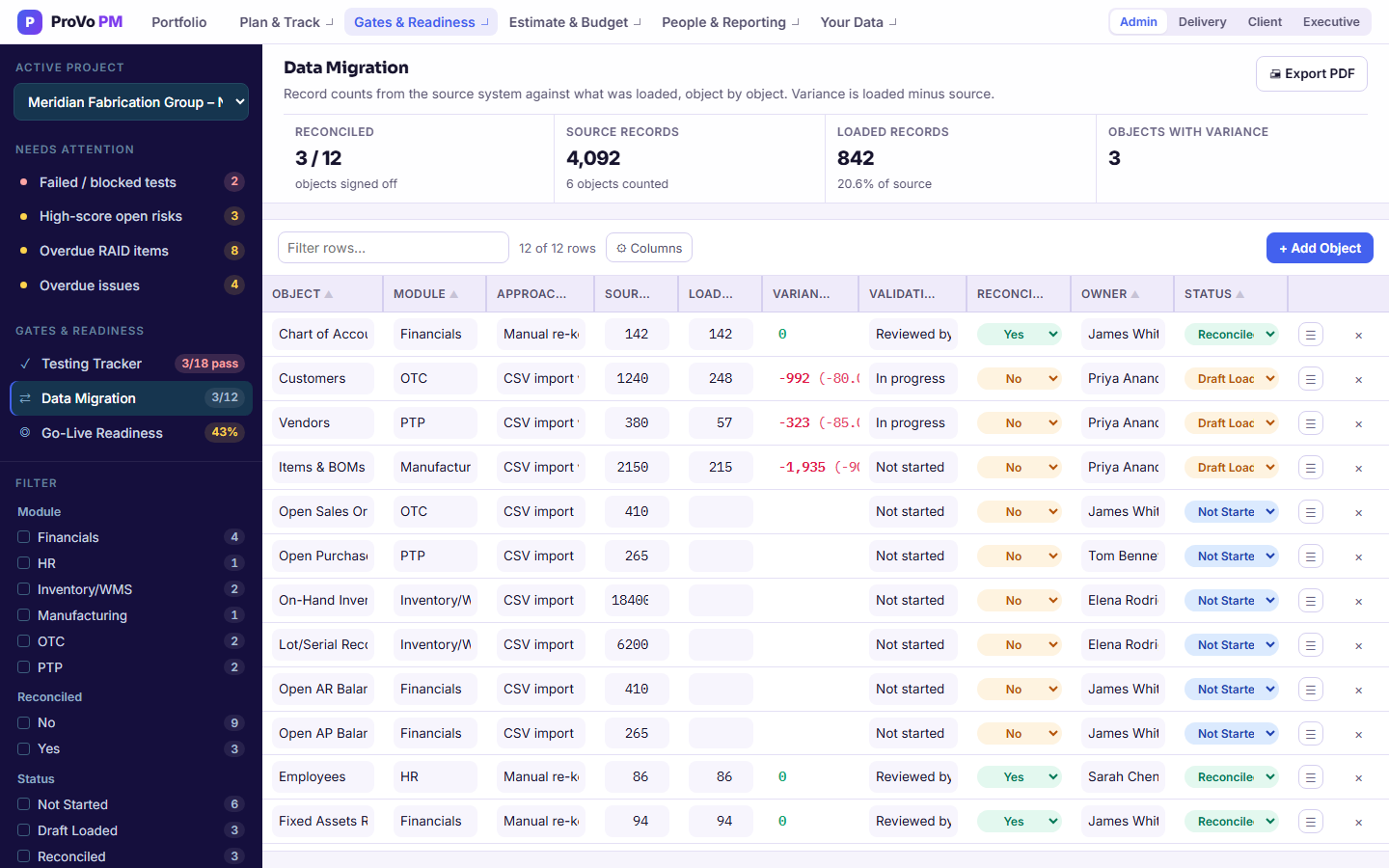
Three of twelve objects are reconciled so far. Three more are draft loaded and six have not started: a real snapshot mid-migration, not a finished one.
Five States
From "Not Started" to Something You Would Sign
Each object moves through the same sequence, so at any point in cutover planning you can see how many objects are still upstream of a dress rehearsal.
Not Started
The object is in scope and nothing has happened to it yet.
Draft Loaded
A first load has gone into a test environment. Expect the variance column to be ugly here; that is what it is for.
Dress Rehearsal
Loaded under cutover conditions, timed, with the real extract and the real sequence. The rehearsal is where you find out the load takes six hours rather than one.
Prod Loaded
In the production system. Counts recorded. Not yet signed off.
Reconciled
A named person has tied it back to source by a stated method and said so. This is the state worth checking before anyone scores the Data dimension on the readiness scorecard.
Track the Thing That Actually Sinks Go-Lives
Load your object list from CSV and start recording counts against it this week.