Handover
The Duties That Never Appear on a Plan
Billing cycles. Contract administration. Portal renewals. Audit support. None of it is a task, because none of it finishes, so none of it is in your work breakdown, and all of it is still yours ninety days after go-live unless somebody hands it over on purpose.
Not a Task List, but a List of Responsibilities
A task has an end. A responsibility has a successor. Tracking the second kind on a tool built for the first kind is why the exit conversation keeps turning up things nobody had thought about.
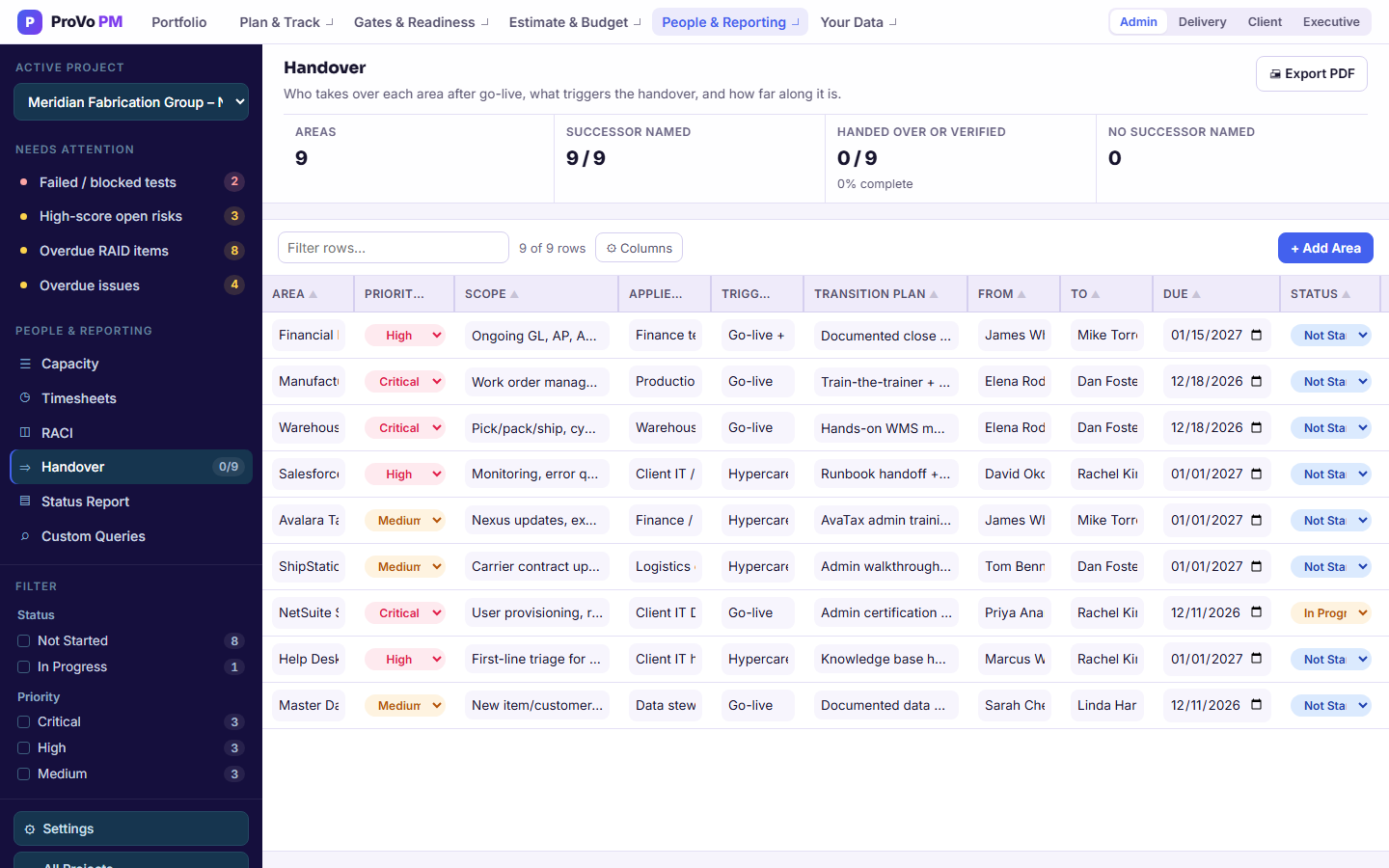
Each row names an area, what it covers, what triggers it, the steps to transition it, who has it now, who is taking it, and when. Headline counts show how many areas have a successor named and how many are handed over or verified. Filter by status or priority, and export the tracker to PDF.
- Area: the responsibility, in the words the client uses for it.
- Priority: critical, high, medium or low.
- Scope and Applies To: which systems, which contracts, which entities.
- Trigger: when it happens. Monthly close. Renewal date. On audit request.
- Transition Plan: what actually has to be done to hand it over.
- From and To: two named people.
- Due: when the handover should be done. Past-due handovers show under Needs Attention in the sidebar.
Why That Rule Exists
Because "TBD" in a handover document is how a firm ends up doing a client's month-end close for free in April. Treating it as a placeholder name lets the row look filled in. Treating it as nobody makes the gap countable, and a number in a steering pack gets resourced in a way a blank cell never does.
Five States
Handed over Is Not the Last One
Most handover trackers stop at "handed over", which records an intention rather than an outcome. This one has a state after it.
Not Started
The responsibility is identified and nothing has happened yet.
In Progress
Transition steps are underway. Documentation, access, walkthroughs.
Shadowing
The successor is doing the work while you watch. This is the state that gets skipped, and skipping it is why things come back.
Handed Over
They own it. You are no longer doing it.
Verified
It has been done once, by them, without you. A renewal actually renewed. A close actually closed. This is the state that lets you leave.
Where It Comes From
Every One of These Is a Thing That Comes Back
A vendor portal that lapses because its renewal was on nobody's plan. A month-end close still being run by the implementer in April. An audit request that lands with the firm that left in November. None of them are tasks, so none of them are in a work breakdown, and all of them are somebody's problem by default, usually yours.
List What You Are Still Holding
Load your handover areas from CSV and see how many of them have a real successor.